





of people in state prisons were first arrested before age 19 — more than 2 in 3.

Youth Advocacy Platform
Ultimate win-win-win system to empower youth advocacy
Uniting pro-bono lawyers, law students, and young clients.
What We Do
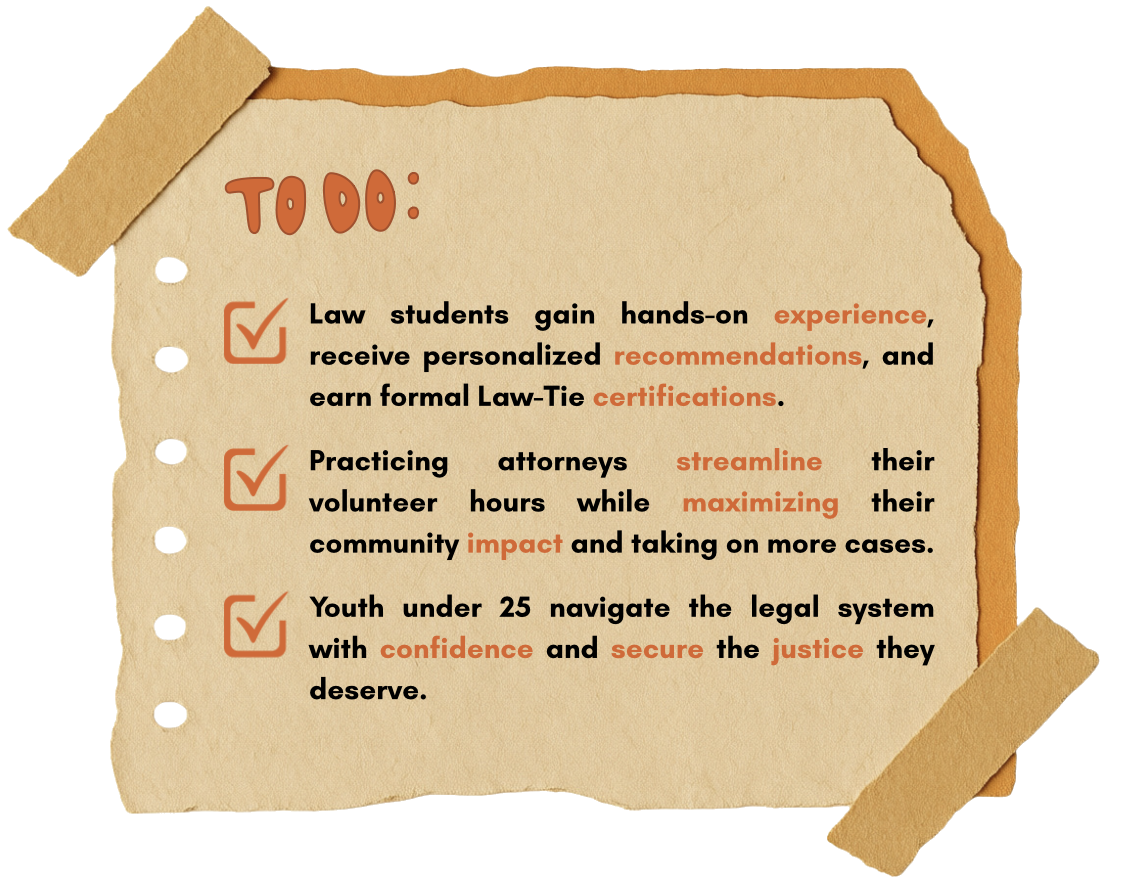
Our Mission
Connecting Law Students with Youth
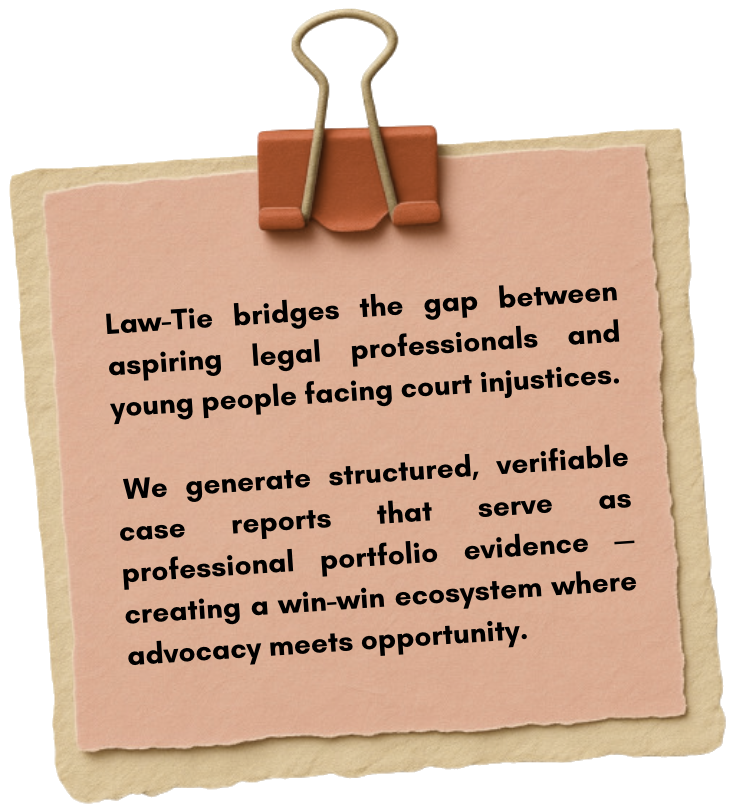
Our mission is to help youth under 25 who lack the knowledge, resources, or authority to advocate for themselves — connecting them with pro-bono lawyers, sided by early-career professionals driven by purpose. Whether facing discrimination in courts because of age, race, or gender, every case submitted to LawTie is reviewed with the utmost care and matched with the most suitable lawyer and law student.

We also help non-citizens
under 35 with their
pro-bono cases!
Step 03
Connect
Click to reveal the definition3. Lawyer Communication & Student Matching
With the client’s consent, Law-Tie communicates directly with their pro-bono lawyer. We clarify the support the case needs, then match suitable law students or early-career professionals according to their knowledge, interests, language, and jurisdiction. The lawyer remains responsible for the case while the matched participant contributes research, accessible explanations, and structured case documentation.
3/3
Step 02
Report
Click to reveal the definition2. Client Case Report & Consent
A young person who already has a pro-bono lawyer can submit a detailed report explaining the case, the problems they are experiencing, and why support from an external law student or early-career professional could help. Before submitting, the client confirms that they have discussed Law-Tie with their lawyer and gives Law-Tie consent to contact that lawyer.
2/3
Step 01
Learn
Click to reveal the definition1. Learn with ChatTIE
Law-Tie builds a learning pathway for young clients, combining law students’ enthusiasm and knowledge with ChatTIE, our law-trained LLM chatbot, to make complex jargon accessible. With the client’s consent, this free AI tool analyzes the court case and creates personalized prior-knowledge lists. Its Socratic tutor structure offers questions and fill-in-the-gap exercises for reflection. Law students learn by explaining concepts in plain language and observing lawyers’ strategies, creating a two-way educational system in which clients and students are active learners.
1/3
The Numbers Don't Lie
Why This Matters
of boys in juvenile facilities are Black, despite Black youth making up only 14% of the under-18 population.
of system-involved youth have experienced serious trauma in their lifetime.
children were held in detention globally in 2024 — a crisis that demands action.
A three-layer initiative
Summing Up
Learn with ChatTIE
Young clients use our free law-trained AI tutor to understand legal language, identify prior knowledge, and reflect through Socratic questions and exercises.
Share the Case Report
Clients explain the case and why student support would help, then confirm their lawyer knows about the program and consent to Law-Tie contacting them.
Connect & Match
Law-Tie communicates with the pro-bono lawyer and matches the case with suitable law students or early-career professionals.